
Leasehold vs Freehold Property in Malaysia: A Professional Guide for 2026

The most expensive title in the market isn't always the smartest choice for your long-term portfolio. While many buyers instinctively lean toward "forever" ownership, the debate between leasehold vs freehold property Malaysia is actually about matching a land tenure to your specific financial strategy for 2026. You've likely felt that familiar pang of worry about the government potentially taking back land or wondered if a bank will even approve a loan for a beautiful home with only 50 years left on its lease. These are valid concerns that can make a major investment feel like a significant risk.
We understand that these complexities often turn an exciting milestone into a source of stress. This guide provides a clear, expert-led framework to help you navigate land titles and make a secure investment decision. We'll examine the practical differences in bank financing, explain the actual costs of lease renewals, and show you how current 2026 market conditions, such as the stable 2.75% OPR, impact your strategy. You'll gain the clarity needed to choose a property that aligns with your goals and provides long-term peace of mind.
Key Takeaways
Define the core distinctions between Pegangan Selamanya and Pegangan Pajakan to determine which title aligns with your multi-generational or short-term investment goals.
Evaluate the financial implications of leasehold vs freehold property Malaysia, including how tenure impacts bank loan margins and potential capital appreciation in 2026.
Navigate the administrative complexities of state consent (Kebenaran Merayu) and understand why certain titles require more deliberate transaction timelines.
Analyze the location-tenure trade-off to decide if a prime leasehold unit in a high-growth urban center outperforms a more remote freehold alternative.
Identify critical Sale and Purchase Agreement (SPA) terms through professional advisory to ensure your property acquisition remains a guided and secure journey.
Table of Contents
Defining Freehold and Leasehold Titles in the Malaysian Context
Understanding land tenure starts with the National Land Code 1965. This legislation serves as the foundation for property rights in Peninsular Malaysia, ensuring that every transaction is documented and legally binding. When you explore the market, you'll primarily encounter two types of titles: freehold and leasehold. Choosing between leasehold vs freehold property Malaysia requires looking past the names and understanding the legal obligations tied to each. These titles aren't just labels; they define your relationship with the State Authority and your long-term rights as an owner.
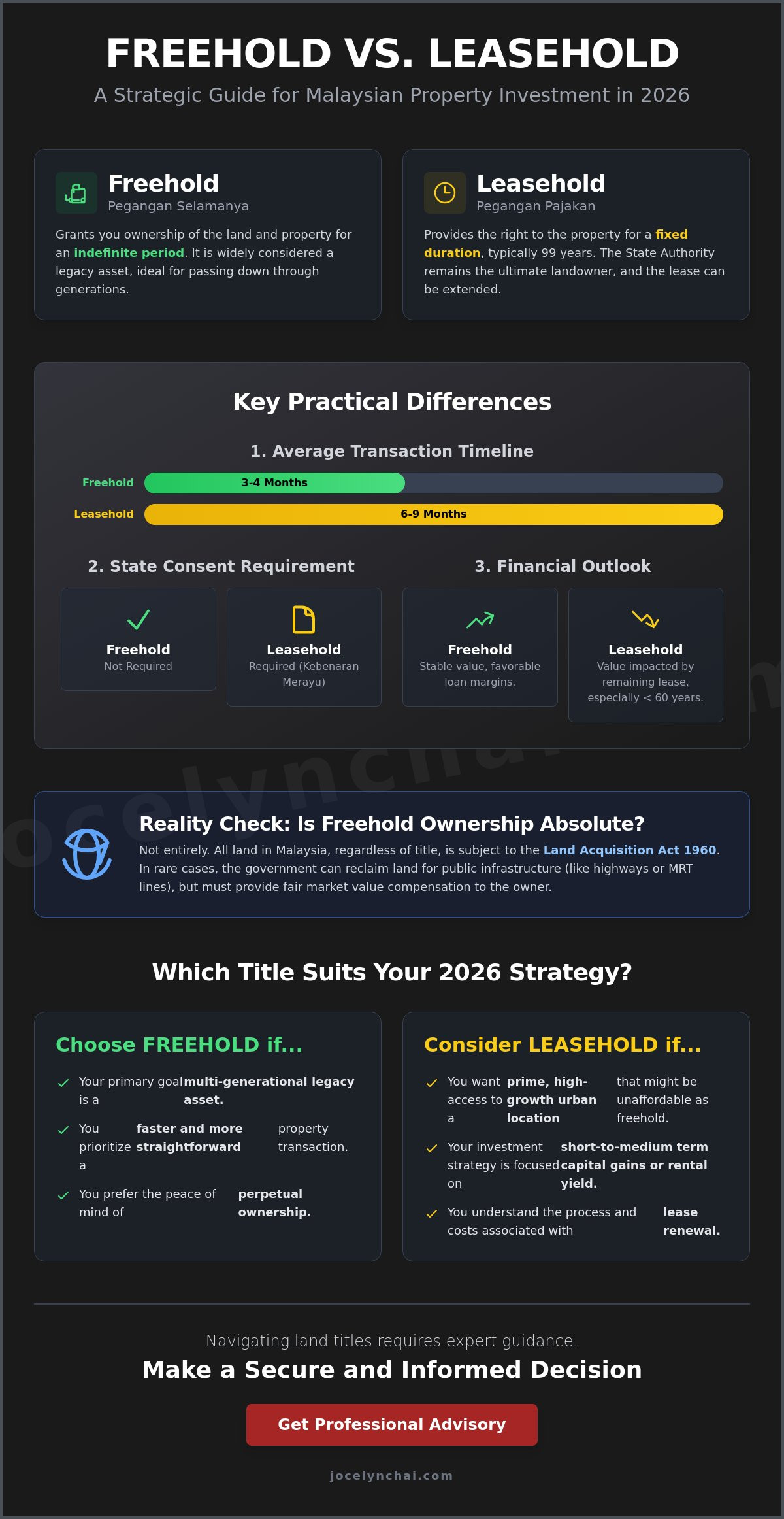
Freehold title, or Pegangan Selamanya, grants you ownership of the land and the structure built upon it for an indefinite period. It's a popular choice for those seeking a legacy asset to pass down through generations. On the other hand, a leasehold title, known as Pegangan Pajakan, provides the right to use the land for a fixed duration, which is typically 99 years. In this arrangement, the State Authority remains the ultimate owner of the land, while you own the rights to the property for the duration of the lease. Both systems are designed to provide a secure environment for investment, though they serve different financial goals.
The Reality of Permanent Ownership
Many buyers believe that a freehold title offers absolute, untouchable ownership. It's helpful to clarify that all land in Malaysia, regardless of title, is subject to the Land Acquisition Act 1960. This law empowers the government to reclaim land for essential public infrastructure projects, such as new highways or rail networks. While this might sound daunting, it's a rare occurrence designed for national development. If your land is ever acquired, the law mandates that you receive fair market value compensation. This ensures your financial interests are protected even in exceptional circumstances.
The Lifecycle of a Leasehold Property
Leasehold properties operate on a timer. The most critical factor for any buyer is the "remaining lease" period. As the lease winds down, the property's market value may fluctuate, particularly when the remaining term drops below 60 years. This threshold is significant because many financial institutions become more selective with loan approvals as the lease nears its end. However, a leasehold title isn't a dead end. Owners can apply for a lease extension from the State Authority before the term expires. This administrative process involves paying a premium to reset the clock, allowing the property to remain a viable and bankable asset for your 2026 property strategy.
The Practical Mechanics of Land Tenure and Government Rights
Administrative procedures often dictate the pace of your property journey. While the legal definitions provide a foundation, the actual experience of buying or selling depends heavily on the administrative requirements set by the State Authority. For those weighing leasehold vs freehold property Malaysia, the most significant practical difference lies in the transfer of ownership. Freehold properties generally allow for a more straightforward transaction, as they do not require formal permission from the state government to change hands. This typically results in a faster completion timeline, often wrapping up within three to four months once the Sale and Purchase Agreement is signed.
Leasehold transactions involve a more methodical progression. You must obtain "Kebenaran Merayu" or State Consent before the sale can be finalized. This additional layer of governance ensures that the land use remains consistent with state planning and demographic policies. Because of this requirement, leasehold transfers often take six to nine months to complete. These extended timelines reflect current Malaysian property market trends where administrative diligence remains a priority for long-term stability. Understanding these mechanical differences helps you plan your moving dates or investment cycles with greater precision. If you find these timelines or procedures complex, a professional property investment consultation can provide the steady hand needed to navigate the paperwork.
State Consent and Transfer Restrictions
Government approval for leasehold sales acts as a regulatory checkpoint. It allows the state to monitor land ownership and ensure that specific quotas, such as those for Bumiputera lots, are maintained. This doesn't mean the transaction is risky; it simply requires more patience. It's also worth noting that some freehold properties are not entirely "restriction-free." Certain freehold developments carry "Bumi Lot" status or other specific caveats on the title that require state consent for a transfer to a non-Bumi buyer. Always verify the specific restrictions on your individual title rather than assuming the tenure type tells the whole story.
Legacy Planning and Family Heritage
The choice between titles often carries a psychological weight. Freehold assets offer a sense of permanent security, serving as a stable cornerstone for multi-generational legacy planning. Many families prefer the "set it and forget it" nature of freehold land when thinking about their children's future. However, leasehold properties can serve as equally effective legacy assets if you manage the renewal process early in the cycle. The 99-year lease serves as the standard starting point for most residential developments in Malaysia. This long duration provides ample time for capital growth and family use before any administrative action is required. Whether you choose a Master Title or a Strata Title, your rights as an owner are protected under the law for the duration of your tenure.
Comparing Financial Performance: Capital Appreciation and Loan Eligibility
Financial decisions shouldn't be based on fear, but on data. When analyzing leasehold vs freehold property Malaysia, the entry price is often the first point of comparison. Leasehold properties generally trade at a lower price point than their freehold counterparts in the same neighborhood. This price gap means you can often secure a larger unit or a property with superior amenities for the same RM600,000 budget. For investors, this lower entry cost is a significant advantage. Because rental rates are primarily driven by location and building quality, leasehold units often deliver higher rental yields compared to more expensive freehold assets nearby.
The long-term performance tells a different story. Freehold properties tend to maintain their value more consistently over decades. While both titles appreciate during market upswings, leasehold assets often reach a "stagnation point" once the remaining lease drops below 60 years. At this stage, the pool of potential buyers shrinks because financing becomes more restrictive. However, if your strategy involves a 10 to 15 year horizon, a well-located leasehold property can often match or even outperform freehold appreciation in the short term. It's about choosing the tool that fits your specific financial timeline.
Lending Criteria in 2026
Banks in 2026 remain focused on the "bankability" of a property's remaining lease. For new launch projects, lenders typically treat leasehold and freehold titles with the same level of confidence, often offering a 90% margin of finance. The challenge arises with older secondary market properties. If a lease has less than 50 years remaining, some banks may reduce the loan amount or shorten the repayment period to ensure the debt is settled before the lease expires. It's wise to verify your specific situation with a trusted property consultant Malaysia to ensure your financing is secure before placing a booking fee.
Growth Potential and Resale Value
Location often acts as a more powerful driver of value than tenure during the first two decades of a property's life. A leasehold condo in a prime transit-oriented development will likely see faster capital growth than a remote freehold terrace house. The key is to understand your exit strategy. If you're looking for immediate cash flow and high rental demand, the lower entry price of leasehold is a strategic tool. If your goal is a multi-generational store of wealth that holds value for 50 years or more, freehold remains the more predictable choice for resale stability.
How to Choose the Right Title for Your 2026 Investment Strategy
Selecting the ideal title isn't about finding a universal "best" option. It's about aligning your purchase with your specific financial goals and personal timeline. When you weigh leasehold vs freehold property Malaysia, start by defining your exit strategy. Are you looking for a home to house three generations of your family, or a high-yielding asset to hold for 10 years? Your answer changes the math. A freehold title offers long-term simplicity, but a leasehold title in a prime urban center can often provide superior immediate cash flow due to its lower entry price. Don't let the tenure type distract you from the fundamental quality of the asset.
Liquidity is another vital factor for your 2026 strategy. Freehold properties generally offer a faster exit in the secondary market because they don't require the state consent process we discussed earlier. This makes them attractive if you value the ability to liquidate assets quickly. However, the location-tenure trade-off is where many savvy buyers find their edge. A prime leasehold spot in a maturing neighborhood often outperforms a remote freehold spot that lacks infrastructure. If you're feeling uncertain about which path fits your portfolio, a professional Property Investment Consultation can help you map out a clear, low-pressure plan.
The Lifestyle Buyer vs. The Strategic Investor
Families often prioritize freehold titles for the emotional peace of mind they provide. Knowing the land is yours indefinitely removes a layer of future administrative worry. For strategic investors, leasehold properties within prime, high-density urban locales are tactical choices. These areas command high rental demand that often offsets any concerns about the lease term. Is leasehold risky for a 10-year hold? The answer is no. Within a decade, the remaining lease stays well above the critical 60-year threshold, ensuring the property remains highly bankable and attractive to future buyers.
The 2026 Market Outlook
Current trends in the Malaysian market show a shift toward quality-driven developments. Modern developers are focusing on "lifestyle ecosystems" where the tenure is secondary to the amenities and connectivity provided. Whether a project is freehold or leasehold, its value in 2026 is increasingly tied to its ESG (Environmental, Social, and Governance) ratings and smart-home integration. To stay ahead of these shifts, you can explore our A Professional Guide to New Launch Property in Malaysia for 2026. Understanding these broader market movements ensures your investment remains resilient, regardless of the land title you choose.
Navigating the New Launch Market with Professional Advisory
The final stage of any property acquisition involves a deep dive into legal documentation. Modern Sale and Purchase Agreements (SPA) have become increasingly complex, often containing specific clauses regarding defect liability periods, late delivery interest, and common area management. While we have explored the structural differences of leasehold vs freehold property Malaysia, the success of your investment often hinges on these finer details. A low-pressure advisory approach is essential during this phase. It allows you to review high-stakes terms without the burden of aggressive sales tactics, transforming a potentially overwhelming experience into a deliberate and manageable journey.
Jocelyn Chai Properties acts as a steady hand in this evolving real estate market. We focus on identifying projects that possess strong growth fundamentals, looking beyond the surface level of marketing brochures. Our role is to provide the high-level expertise needed to interpret how current regulations, such as the 2026 stamp duty exemptions for first-time buyers, impact your specific purchase. This methodical approach ensures you remain in control of the process, reinforcing your confidence as you move from initial interest to final ownership.
Expert Guidance for New Developments
Finding "hidden gems" in the new launch market requires a dedicated specialist who understands urban planning and developer track records. We help you identify projects where the entry price is strategically positioned for future appreciation, regardless of the land tenure. Navigating the early-stage purchase process, from securing a booking to managing loan disbursement, requires precision. Professional advisory simplifies this transition, removing the guesswork and ensuring that every administrative milestone is met with ease. This supportive service allows you to focus on the excitement of your new home or investment while we manage the underlying complexities.
Your Partner in Property Investment
We believe that property ownership should be a source of long-term security rather than stress. Our commitment is to provide a guided experience that prioritizes your peace of mind. Building a resilient portfolio requires looking at the broader financial landscape, which is why we offer a strategic property investment consultation Malaysia. This service helps you align your acquisitions with your personal time horizons and cash flow needs. Ultimately, the land title is just one piece of the puzzle. Whether you choose freehold for its legacy value or leasehold for its tactical urban advantages, we help you see the whole picture to ensure your 2026 property strategy is both secure and successful.
Securing Your Property Future in 2026
The choice between leasehold vs freehold property Malaysia is a strategic decision that shapes your financial legacy. You now understand that while freehold offers permanent ownership, leasehold serves as a tactical tool for higher yields in prime locations. Success in the current market requires balancing these land titles with your specific time horizon and the property's growth fundamentals. Navigating administrative requirements and bank lending criteria is much simpler when you have a clear framework to follow. It's about finding the right fit for your unique lifestyle and investment goals.
As a specialist in New Launch Property Advisory, I provide the steady hand needed to navigate this complex market. My approach offers professional, low-pressure guidance and expert market analysis for the 2026 Malaysian real estate landscape. I'm here to ensure your journey from searching to owning is both transparent and secure. To begin your next chapter with confidence, Book a Professional Property Consultation with Jocelyn Chai. Together, we can turn your property aspirations into a well-managed and successful reality.
Frequently Asked Questions
Can a leasehold property be converted to freehold in Malaysia?
Conversion from leasehold to freehold is not a standard administrative process in Malaysia. While certain states have occasionally introduced specific policies allowing for such conversions under very limited conditions, these are rare exceptions rather than the rule. Most owners should plan their investment assuming the land tenure remains as stated on the original title issued by the State Authority.
Is it harder to get a bank loan for a leasehold property?
Securing a bank loan for a leasehold property is straightforward for new developments and properties with over 60 years remaining on the lease. However, lenders become more cautious as the lease term diminishes. If a property has less than 50 years left, some banks may reduce the margin of finance or shorten the loan tenure to ensure the debt is settled before the lease expires.
How much does it cost to renew a leasehold title?
The cost to renew a leasehold title is calculated using a specific formula determined by the respective State Authority. This premium is typically based on the property's current market value, the land size, and the number of years being added to the lease. Because these rates are subject to state-specific regulations, it is best to consult the local Land Office for a precise valuation tailored to your specific lot.
Why are freehold properties usually more expensive than leasehold?
Freehold properties usually command a higher market price due to their perceived "forever" ownership and the absence of state consent requirements for transfers. This scarcity, combined with the psychological security of permanent land rights, creates higher demand in the secondary market. When comparing leasehold vs freehold property Malaysia, you'll often find that leasehold units offer a lower entry point, making them more accessible for many buyers.
Can the government take back my freehold property?
Yes, the government can reclaim freehold land under the Land Acquisition Act 1960 for public infrastructure projects such as highways or transit lines. While freehold status provides indefinite ownership, it doesn't exempt the land from national development needs. In these rare instances, the law requires the government to provide fair market value compensation to the owner for the loss of the property.
What happens to my house if the 99-year lease expires?
If a 99-year lease expires without a renewal application, the land and any structures on it legally revert to the State Authority. To prevent this, most owners apply for a lease extension once the remaining term falls below 30 or 40 years. This proactive approach ensures the property remains a bankable asset and allows you to continue occupying or renting out the home without legal interruption.
Is leasehold or freehold better for rental yield?
Leasehold properties often deliver superior rental yields because they typically have a lower purchase price compared to freehold units in the same neighborhood. Since tenants generally prioritize location, amenities, and interior quality over land tenure, they are often willing to pay the same rent for either title type. This allows leasehold investors to achieve a higher percentage return on their initial capital investment.
How do I check if a property is freehold or leasehold?
You can verify a property's tenure by reviewing the "Geran" (Title Deed) or by conducting a private land search at the relevant Land Office. The document will explicitly state whether the land is held in perpetuity or for a fixed term, along with the specific expiry date for leasehold titles. For new launch projects, this information is clearly outlined in the Sale and Purchase Agreement and the developer's marketing materials.



Comments